
Furiosa and the Clash of the Patriarchs

Updated: Mar 10

Brutality in Times of Plenty
“It is certainly not difficult to find ethnographic and historical examples of trafficking in women. Women are given in marriage, taken in battle, ex-changed for favors, sent as tribute, traded, bought, and sold.
Far from being confined to the "primitive" world, these practices seem only to become more pronounced and commercialized in more "civilized" societies. Men are of course also trafficked-but as slaves, hustlers, athletic stars, serfs, or as some other catastrophic social status, rather than as men. Women are transacted as slaves, serfs, and prostitutes, but also simply as women.”
- Gayle Rubin, The Traffic in Women, Notes on the Political Economy of Sex
Think of world history. Our nature is to hoard and accumulate. War, raiding, pillaging, conquering and mass slavery. It’s nothing new. It’s why I love post-apocalyptic scenarios. They just show us what we’ve always been, a patriarchy by default.
Take Russia’s severe economic downturn in the 1980’s. Women and girls were immediately trafficked into the flesh trade and their bodies monetized by traffickers---their submissiveness advertised as the antithesis of the modern woman. It was an advertising campaign with women as products. To turn the lens closer to home, recorded dowry related deaths have been a steady trend in India, women whose families could not pay their in-laws enough to for their daughters to live. Yet, funnily enough, it took one man’s suicide for the Supreme Court to declare that “Marriage is not a commercial venture”. For more than thirty years, the skewed sex ratio as a result of female infanticide and foeticide, both in India and China, led to a shortage of women and girls and further led to bride trafficking, the literal buying and selling of girls for marriage. In India, the problem of exploitative surrogacy, wombs for rent, became so prevalent and cheap that the government had to crack down on the thriving business with new laws restricting foreign buyers. 80% of organ donors in India are women and 80% of organ recipients are men.
Women and girls have been a resource for sexual use, for breeding, child rearing and domestic labour, in service of the economic system we’re all forced to embrace. Enforced by violence, the barter system in women and girls has long existed: for trade, for alliances and for expansion.
The Movie

Dementus, the primary antagonist in Furiosa-A Mad Max Saga, makes little Furiosa watch as he tortures her mother to death. He keeps Furiosa alive only as a ‘blood bag’, because her body is free from disease and congenital defects, having been raised in a haven far from the exploitative, irradiated hellscape ruled by an alliance of patriarchs.

Immortan Joe is a warlord who commandeered the main water resource. He breeds a small army of brainwashed “war boys” who serve him with religious zeal. Ready to sacrifice their lives for him with the promise of a warrior’s afterlife, much like any old patriarchal religion does, they carry out his bidding and help maintain his authority. His seraglio of wives----literally ‘breeders’----their survival dependent on producing him healthy babies, is replenished with trafficked girls. When they run out of chances at birthing a healthy child, they are pumped for breastmilk, exchanged for oil from Gas Town.
The Guardian of Gas Town is the most genteel, if not the weakest of the lot. A lover of the arts and literature, he maintains a profitable alliance with Immortan Joe until Dementus attacks Gas Town and captures him, winning it in a bargain with Immortan Joe.
Dementus isn’t much of a ruler and runs Gas Town to the ground in about ten years. Unable to control the rebellion of Gas Towners he runs away to save his skin, with the now grown Furiosa in pursuit. Between the remaining patriarchs, Immortan Joe is the most organized. He is ruthless and controls his fortress from top to bottom with great efficiency, keeping the lion’s share of resources for himself.
What is a ‘good’ Patriarch?
For the patriarch, legacy does not pertain to one’s children’s welfare necessarily, instead, it pertains to his immortality, his seed, passed on forever, his name remembered through his children. His rules, his religion, apply as well, long after he is gone. A patriarch will continue to exert his control long after he is turned to dust----it’s how he lives forever.
For the longest time, the patriarch has been a representative of the state. His primary drive is legacy. To be remembered, he passes on his name, the passing on of resources to his progeny an allowance from the State for good behaviour and hard work. No matter how lousy a patriarch, no matter how small his home, females, both burden and resource, are subordinate to him. Any sort of freedoms accorded to women, the right to vote, reproductive rights, the right to own property or the right to have a bank account, have had to be fought for.
In post-independent India, a good patriarch took care of his female progeny by gifting them assets like land to circumvent, at the time, the gender-biased laws of inheritance. All my older female relatives were expected to go to college and eventually work, but they were also expected to do the bulk of the housework and child rearing. It was the most progressive form of patriarchy you could visualize for the time. Just one generation previous, a girl would be lucky to have a basic high school education before being married off. A patriarch can be a good thing, if the system that supports him decentres him.
Patriarchy vs Matriarchy
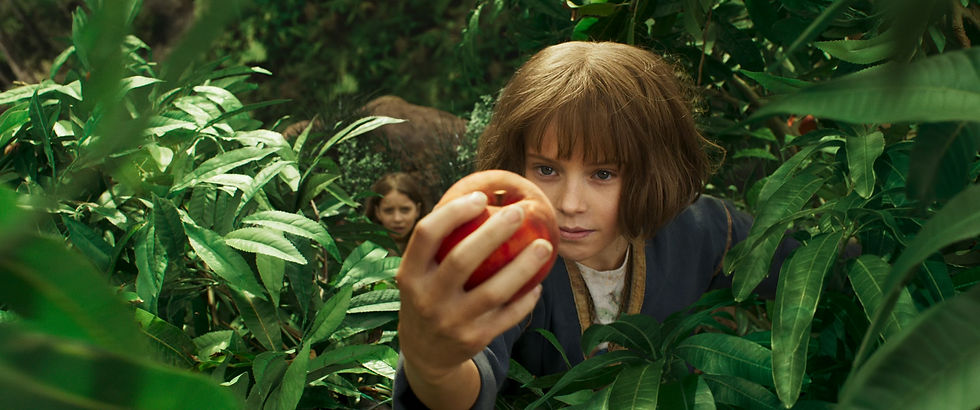
Patriarchies are male centred with women and children subordinate no matter what class, whereas matriarchies are designed to put children first. An ideal matriarchy understands the earth, understands its cycles and functions at a sustainable, not an exploitative, level.
Matriliny and at least one functioning matriarchy in China, now a popular tourist spot, have survived the test of time. A neo-matriarchy, Umoja, in the country of Kenya, sprouted out of abuse and rebellion, and after multiple attempts to burn it to the ground, managed not only to survive, but is now a thriving community run by women.
In the Mad Max universe, a lush oasis in the middle of a toxic, post-apocalyptic land, with a semi modern village ruled by The Many Mothers or the Vuvalini, is such a matriarchy. Children, educated about the delicate balance of nature, carry a whistle around their necks to warn of intruders.
Furiosa is kidnapped. Her mother nearly rescues her from her kidnappers but is undone by an act of mercy—sparing one of Dementus’s minions who utters the sacred words, “I’m a mother too.” She is betrayed immediately. The minion calls for help, and she is captured and tortured before Furiosa’s eyes.

Matriarchy or otherwise, the young of any species are vulnerable. Brought into the world with blood and pain, they demand the highest form of protection through the mother-child bond and by extension the circle of aunts, uncles, grandparents, siblings and cousins that protect them from harm and tend to their growth. (If I sound like I’m talking about a herd of elephants or a pod of orcas, then I can’t think of more excellent examples).
Upend that system and children suffer immediately, and if they manage to survive, spread the destruction sideways and forwards to future generations. This destruction begat a nihilist like Dementus. His twisted affection for Furiosa goes beyond her purity---he considers her an extension of himself, a progeny of sorts, reenacting his own traumatic childhood by killing her mother before her eyes, and passing on his trauma.
It calls for a shift to survival mode, of adapting to survive, of appreciating the crumbs of affection and protection that Dementus is willing to bestow upon her. Furiosa, however, has been thoroughly loved, and does not submit. She bides her time and never loses hope of returning to The Green Place.
Matriarchy Gone Sour
What can destroy a matriarchy? In the Mad Max universe, it is environmental decay----resources spread thinner than ever—and they’re realistic about this in the script.
Angharad, in Fury Road, calls bullets ‘anti-seed’, a censure of the militaristic nature of Immortan Joe’s kingdom of violence. She is the Breeders’ matriarch and does not accept the hierarchical role---the absolute objectification of herself and her seraglio sisters. She and her sisters can afford a more idealistic view of the world because of their access to Immortan Joe’s resources.

After the environmental collapse of The Green Place and its decay into a lifeless bog, the remaining Vuvalini must get food whichever way they can. Because they couldn’t grow it anymore, they resorted, with no crisis of conscience, to cannibalism. “Thought somehow you girls were above all that,” says one of the Breeder escapees. The Vuvalini elder shows her treasure of heirloom seeds, “Trees, flowers, fruit,” she says, “Back then everyone had their fill. Back then there was no need to snap anybody.”
To further illustrate the extremes to which the Vuvalini have taken their survival philosophy, when the one of Immortan Joe’s victims mentions she’s carrying ‘Warlord Junior’ the Keeper of Seed suggests it could be a girl (and thus worth having). When the The Green Place turned into a bog, the Vuvalini separated from the males in their community, who stayed behind and became the Crow Fishers. The Vuvalini don’t have any children, because the resources to support such an excess are unavailable, and it was best if they didn’t reproduce. They are, therefore, free of men and have fewer problems; their philosophy intact, a harsh matriarchy in harsh surroundings, preserving what little they can.
In Fury Road, Immortan Joe’s death signifies a redistribution of resources. An ex-Breeder, exploited for her milk, releases the life-giving water to the thirsty crowd below.
Apocalypse Now
We’ve untangled the lie that women need to be protected by men for their own good; exchange the word women or girls with ‘resource’ and you’ll get what men were actually protecting. When we talk about civilization, it is dishonourable for one patriarch to steal another’s resource---exchange are barter for resources is considerably more respectful and has longevity, much like the system that Immortan Joe had worked out with the other patriarchs.
In patriarchy as we currently know it, women and girls are the product, and if women are objectified in times of plenty, is anyone really surprised by the savagery of the post-apocalyptic Mad Max world, when resources are spread thin? If one reads of the mass organized ways in which colonizers decimated indigenous populations and stole their resources and labour…well, no surprise. We’ve been practicing for the apocalypse for the longest time ever.
Think of world history. Our nature is to hoard and accumulate. Wars, raiding, pillaging conquering. It’s nothing new. Corruption is just another form of theft and accumulation.
So, tell me again, what is so ‘post-apocalyptic’ about the Mad Max world?
Comment Policy
This space is for thoughtful, on-topic discussion. Comments that include links, sound like spam, or are intended to provoke rather than contribute will be deleted.


Very thought provoking.